
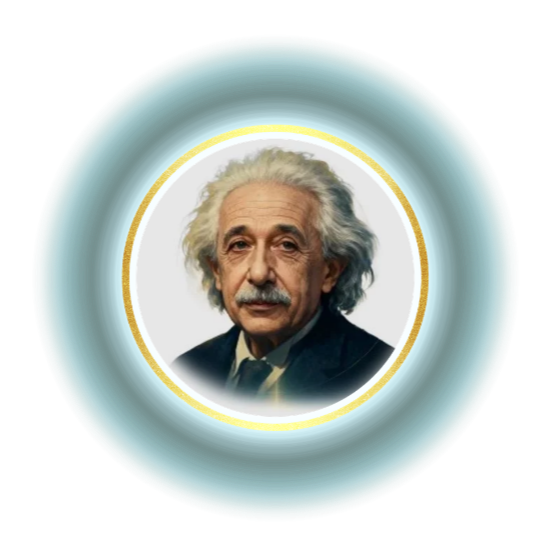
Einstein Section: Did You Know?
His younger sister Maja was his closest confidante. Although an oft-repeated anecdote about his first remark on her birth (“But where are its wheels?”) is likely apocryphal, Maja remained deeply close to Einstein throughout his life and later lived with him in Princeton, where he reportedly read to her regularly after she lost her sight.
A teacher once dismissed his potential. Einstein recalled that a teacher at the Luitpold Gymnasium told him he would “never amount to anything,” reflecting his early resistance to rigid schooling.
Einstein had a secret daughter. In 1902, before his marriage to Mileva Marić, they had a daughter named Lieserl. Her fate remains unknown after she disappeared from the historical record in 1903.
Music helped him think. When stuck on difficult problems, Einstein often played his violin, nicknamed “Lina,” believing that music helped him think intuitively beyond equations.
His divorce anticipated a Nobel Prize. Einstein’s 1919 divorce settlement specified that any future Nobel Prize money would go to Mileva and their children, an agreement he honored after winning the prize.
A skeptic proved him right. Physicist Robert Millikan initially doubted Einstein’s explanation of the photoelectric effect and spent years testing it experimentally. His results confirmed Einstein’s theory and ultimately earned both men Nobel Prizes.
GPS relies on relativity. The GPS in every mobile phone would be off by miles every day if it didn't use Einstein’s general theory of relativity to correct for time ticking faster on satellites than on Earth.
His older son became a leading engineer. Einstein’s son, Hans Albert, became a renowned professor of hydraulic engineering at UC Berkeley, earning distinction in his own right.
His younger son’s life was tragic. Eduard Einstein was a gifted musician and student who later developed schizophrenia and spent much of his adult life in Swiss institutions.
He was close to his second family. Einstein developed a deep bond with his two stepdaughters from his second marriage to Elsa; the eldest, Ilse, served as his secretary for years, while the younger, Margot, was a gifted sculptor who lived with him in Princeton until his death.
Einstein refused to wear socks. He found socks unnecessary and disliked how they wore out, maintaining the habit even during formal occasions.
He was uncomfortable with fame but used it strategically. Although celebrity embarrassed him, Einstein leveraged public attention to speak out on pacifism, civil rights, and nuclear disarmament.
Einstein was outspoken on American civil rights. After moving to the United States, he condemned racism as “America’s worst disease” and supported Black scholars and activists.
The FBI kept a massive file on him. Due to his political views and activism, the FBI monitored Einstein for over twenty years, compiling more than 1,400 pages.
He never learned to drive. Einstein preferred walking or being chauffeured and joked that cars distracted people from more important thoughts.
He became a vegetarian late in life. Although sympathetic to vegetarian ethics for decades, Einstein adopted a strictly meat-free diet only in his final year.
He admired Mahatma Gandhi. Einstein praised Gandhi as a moral role model for humanity and drew inspiration from his philosophy of nonviolent resistance.
His brain was taken after his death. Following Einstein’s death in 1955, a pathologist removed his brain without prior family consent and preserved it for decades for study, a decision that remains controversial.